Opal Kelly will be at SPIE Photonics West 2027, February 2 to 4 at Moscone Center, with live demos of the SYZYGY Hub, FrontPanel 6, and machine vision on the XEM8320. Booth 2365.
Blog date
October 9, 2026
Visit Us at Photonics West 2027 (Booth 2365)
SPIE Photonics West 2027
We're heading back to San Francisco for SPIE Photonics West 2027. The exhibition runs February 2 to 4 at Moscone Center, and we'll be at Booth 2365 with live demos of the SYZYGY Hub, FrontPanel 6, and the XEM8320 with SYZYGY peripherals.
At Photonics West 2026 we met several teams developing photonics applications, from optical coherence tomography (OCT) to quantum sensing, who had not yet considered an FPGA-based architecture. We wrote up where FPGAs fit in Why You Should Consider an FPGA for Your Photonics Application, and this year's demos show that architecture on real hardware: the FPGA handles capture, timing, and data reduction, and the host PC handles analysis and the interface.
What we're showing
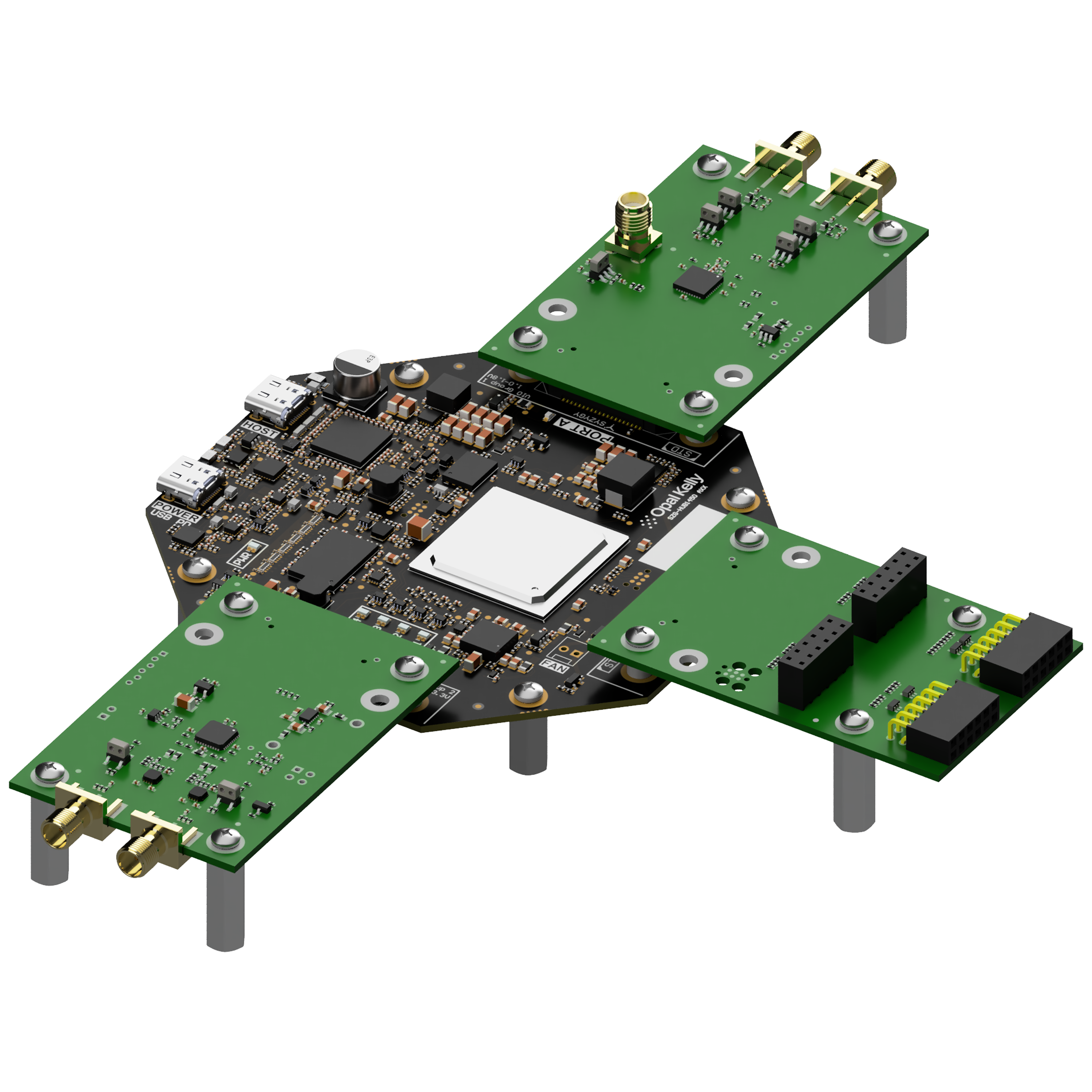
The SYZYGY Hub is new since last year's show. It puts an AMD Artix UltraScale+ FPGA, three SYZYGY Standard ports, and a USB 3.2 Gen 2 (10 Gbps) host connection on one board, and it ships with FrontPanel 6, example apps, and pre-built gateware. Swapping the peripheral turns the same Hub into a digitizer, a camera interface, or a multi-channel data acquisition system.
FrontPanel 6 runs FPGA applications in the browser. A FrontPanel Platform app is a standard TypeScript and React project that streams data, sets registers, and plots results, and one codebase runs on Windows, macOS, Linux, and Raspberry Pi. The Python, C++, C#, and Java APIs are still there for teams working in Jupyter, LabVIEW, or their own host code. On the SYZYGY Hub, an MCP server lets AI tools such as Claude Code and Cursor read from and control the FPGA in plain language.
The SYZYGY Hub with ADC, data-acquisition, and breakout peripherals on its three SYZYGY ports.
Demo lineup
Digitizer and scope on the SYZYGY Hub. A digitizer peripheral on the Hub streams captures to a FrontPanel 6 scope app in the browser. It is the same arrangement a lab uses to characterize a detector, a photodiode signal chain, or an ADC front end, with the FPGA capturing and the host displaying and analyzing.
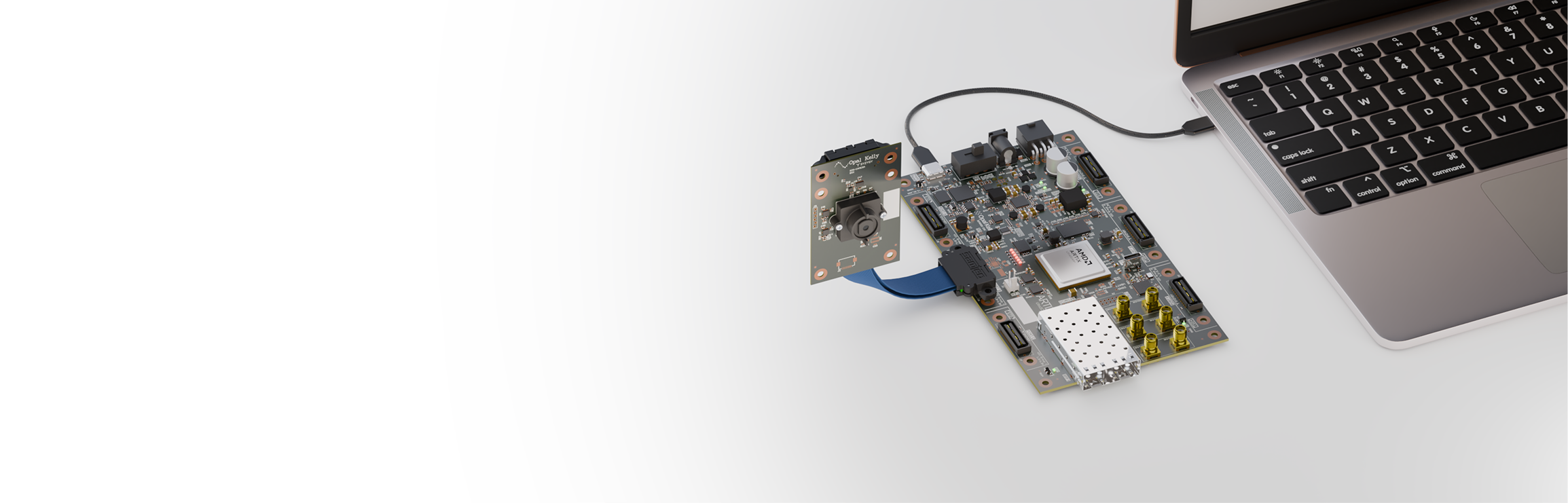
Machine vision on the XEM8320. An XEM8320 pulls video from a SYZYGY camera peripheral and handles capture and preprocessing in the FPGA. TensorFlow on the host runs object detection and overlays the results on the live feed. A new model goes onto the PC without touching the gateware. Optical inspection and imaging systems use the same split.
Machine vision demo. The XEM8320 handles camera capture and preprocessing, and the model runs on the laptop.
Where FPGAs fit in photonics
Many photonics systems need timing and throughput that a CPU or GPU cannot guarantee on its own. These are the applications where FPGAs come up most:
Optical coherence tomography (OCT). Real-time FFTs on interference patterns run in hardware, so live-view imaging keeps pace for surgical guidance and diagnostics.
Fluorescence lifetime imaging (FLIM). Time-to-digital converters in the FPGA fabric timestamp photon arrivals with picosecond resolution.
LiDAR and time-of-flight. The FPGA correlates laser pulses and generates point clouds with the low latency that autonomous systems and 3D mapping require.
Adaptive optics. Wavefront corrections are calculated and applied to deformable mirrors at kilohertz rates, in astronomy and in medical imaging.
Moving that processing into the FPGA gives deterministic latency, since no operating system or interrupt sits in the signal path. It reduces data before it reaches the USB or PCIe link, through filtering, decimation, or peak detection in the fabric. It also gates out dark counts from single-photon detectors in hardware, so only relevant events are recorded. The full breakdown is in Why You Should Consider an FPGA for Your Photonics Application.
Photonics teams building on Opal Kelly
Pi Imaging Technology builds its SPAD cameras on the XEM7310 and XEM7360.
Pi Imaging Technology builds SPAD (single-photon avalanche diode) cameras for low-light, time-resolved imaging. Its SPAD 512 camera uses a 512×512 sensor at up to 100,000 fps and replaces EMCCD cameras in wide-field microscopy. Pi Imaging uses the XEM7310 and XEM7360 to handle high-speed I/O and process photon events in the FPGA fabric, with photon-time tagging at 20 ps resolution.
“As a company that needs to move fast, we needed a complete and ready-to-use FPGA solution. Opal Kelly's hardware offered a platform that we could integrate quickly.”
Swabian Instruments makes the Time Tagger series, data acquisition instruments used in quantum optics and physics research at institutions including MIT and Max Planck. Its streaming time-to-digital converter runs in the fabric of an XEM7360-K410T (AMD Kintex-7) and resolves timestamps down to 2.7 ps, and FrontPanel streams those timestamps to the PC for processing in software. Working with Single Quantum on superconducting nanowire detectors, Swabian measured 7.6 ps RMS total jitter.
“If it wasn't for Opal Kelly, our company would not exist. It would have been too complicated to create our solutions. Opal Kelly gave us an easy way to get started, saving us a lot of time and work and enabling us to focus our expertise on our unique products.”
The Ion Storage Group in NIST's Time and Frequency Division built an open-source digital servo on the XEM6010 for laser feedback control in atomic, molecular, and optical (AMO) physics experiments. The hardware, firmware, software, and enclosure designs are on GitHub.
Who should stop by
Research groups validating algorithms or testing optical setups
OEM engineering teams moving from evaluation to design-in
Imaging and optical developers working with high-speed sensor pipelines
Teaching labs introducing FPGAs
Test and validation teams that need repeatable procedures
Where to start
These are the modules we'll point most photonics teams to at the show.
If you're working on an imaging pipeline, an optical measurement system, or real-time instrumentation, stop by Booth 2365 to see the demos and talk through your setup with our team. To set up a meeting at the show ahead of time, contact us.
Plan your visit
Book time with our team ahead of the show, or read more on where FPGAs fit in photonics.



 SYZYGY Hub
AMD Artix UltraScale+
Best for: Labs trying FPGAs for the first time, and teaching labs.
SYZYGY Hub
AMD Artix UltraScale+
Best for: Labs trying FPGAs for the first time, and teaching labs.
 XEM8320
AMD Artix UltraScale+
Best for: Machine vision and modular sensor front ends.
XEM8320
AMD Artix UltraScale+
Best for: Machine vision and modular sensor front ends.
 XEM8370
AMD Kintex UltraScale+
Best for: Instruments that need the most fabric for real-time processing.
XEM8370
AMD Kintex UltraScale+
Best for: Instruments that need the most fabric for real-time processing.
 XEM8350
AMD Kintex UltraScale
Best for: Streaming high-bandwidth raw data to the host.
XEM8350
AMD Kintex UltraScale
Best for: Streaming high-bandwidth raw data to the host.


