


Overview
Overview

We were at Photonics West in San Francisco in January. During the exhibition, we met with several teams developing impressive photonics applications—ranging from Optical Coherence Tomography (OCT) to quantum sensing—who had not yet considered an FPGA-based architecture.
For many of these applications, the transition from traditional processing to a Field Programmable Gate Array (FPGA) is the primary path to overcoming data bottlenecks and achieving real-time performance.
Why FPGAs are Utilized in Photonics
Why FPGAs are Utilized in Photonics
Photonics applications often require deterministic, high-bandwidth processing that standard CPUs or GPUs cannot provide. FPGAs are uniquely suited to several key areas:
- Optical Coherence Tomography (OCT): OCT requires massive computational throughput to perform real-time Fast Fourier Transforms (FFTs) on interference patterns. An FPGA allows for "Live View" imaging by processing these transforms in hardware, enabling surgical guidance or diagnostic feedback without the lag associated with software-based processing.
- Fluorescence Lifetime Imaging Microscopy (FLIM): Measuring the decay rate of fluorescent samples requires sub-nanosecond timing. FPGAs implement Time-to-Digital Converters (TDCs) directly in the fabric to timestamp photon arrivals with picosecond resolution.
- LiDAR and Time-of-Flight (ToF): For autonomous systems and 3D mapping, FPGAs handle the high-speed correlation of laser pulses and the resulting point-cloud generation, ensuring the low latency required for safety-critical decisions.
- Adaptive Optics: In astronomical or medical imaging, FPGAs calculate and apply wavefront corrections to deformable mirrors in real-time, compensating for atmospheric or tissue-induced distortion at kilohertz rates.
Key Technical Advantages
Key Technical Advantages
Moving processing to an FPGA provides three specific benefits over traditional PC-based acquisition:
- Deterministic Latency: Unlike a CPU, which must manage background OS tasks and interrupts, an FPGA provides a dedicated hardware path. This ensures every pulse is processed with the exact same timing, which is critical for synchronization in quantum optics.
- Parallel Data Reduction: Instead of streaming raw, high-bandwidth data to a PC—which often bottlenecks at the USB or PCIe bus—the FPGA can perform initial filtering, decimation, or peak detection in-situ. This "smart data acquisition" reduces the load on the host software.
- Hardware-Level Gating: FPGAs can implement extremely fast logic gates to filter out noise or "dark counts" in single-photon detectors, ensuring that only relevant data is recorded.
Customer Spotlight: Accelerating Innovation in Photonics
Customer Spotlight: Accelerating Innovation in Photonics
The journey from a lab-bench prototype to market-ready instrumentation is frequently stalled by the heavy engineering lift required for custom drivers, firmware, and high-speed connectivity logic. By pairing their core innovations with Opal Kelly’s off-the-shelf integration modules and the FrontPanel SDK, industry leaders are able to make the critical link between hardware and the host PC entirely "frictionless". This platform-based approach enables rapid development and accelerated design cycles, allowing teams to bypass years of low-level infrastructure development and focus their high-value resources on their core photonics innovations.

Pi Imaging Technology is revolutionizing light detection through SPAD (Single-Photon Avalanche Diode) technology, which offers unprecedented sensitivity and speed for low-light, time-resolved applications. Their flagship SPAD 512 camera integrates a 512×512 image sensor capable of frame rates up to 100,000 fps, effectively replacing traditional EMCCD cameras in wide field microscopy.
Handling the massive data throughput of a 512×512 array requires a robust processing backbone. Pi Imaging utilizes the Opal Kelly XEM7310 and XEM7360 modules to manage high-speed I/O and real-time processing of photon events directly in the FPGA fabric. This architecture enables photon-time tagging with an incredible 20 ps resolution, providing functional information about molecular function and environment that intensity-only cameras simply cannot capture.
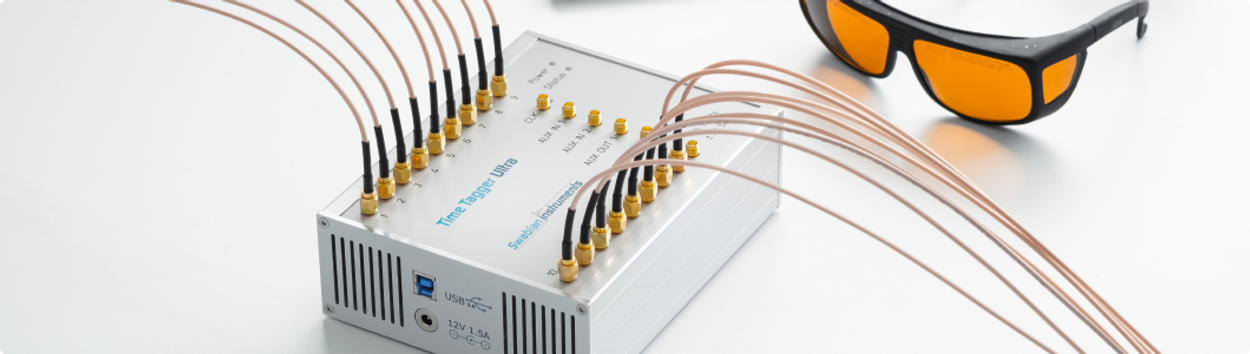
Swabian Instruments has emerged as a leader in the physics research community with their Time Tagger Series, a suite of digital data acquisition tools used by world-renowned institutions like MIT and Max Planck. Their core innovation is a streaming Time-to-Digital Converter (TDC) implemented in the FPGA fabric that can resolve time stamps down to 2.7 picoseconds—pushing far into the microwave domain.
To achieve this, Swabian leverages the Opal Kelly XEM7360-K410T, a high-gate-count module based on the Xilinx Kintex-7. The FrontPanel SDK provides the "frictionless" interconnect needed to stream these precise timestamps to a PC for flexible software-level processing without sacrificing hardware fidelity. This integration enables highly demanding applications, such as achieving a 7.6 ps RMS total jitter in collaboration with Single Quantum for superconducting nanowire detection.
“If it wasn’t for Opal Kelly, our company would not exist. It would have been too complicated to create our solutions. Opal Kelly gave us an easy way to get started, saving us a lot of time and work and enabling us to focus our expertise on our unique products.”
— Helmut Fedder, CEO, Swabian Instruments
Pushing the Limits: The Next Generation of Photonics
Pushing the Limits: The Next Generation of Photonics
As photonics applications move toward multi-megapixel machine vision and quantum networking, the need for increased logic density and sustained throughput is critical. To meet these requirements, we have expanded our high-performance lineup to include the latest UltraScale+ and UltraScale architectures.
For the most resource-intensive scientific instrumentation, the XEM8370-KU11P serves as our premier integration module. Built on the Kintex UltraScale+ architecture, it provides over 650,000 logic cells and 2,900+ DSP slices, offering the necessary headroom for complex real-time processing and advanced prototyping.
The XEM8320-AU25P is designed for maximum modularity and flexibility at the edge. As a dedicated expansion platform, it features six integrated SYZYGY® ports—including four Standard and two high-speed Transceiver (TXR4) ports. This ecosystem allows researchers to quickly interface with a wide variety of off-the-shelf sensors and converters, bypassing the need for custom board development.
For applications requiring high throughput, the XEM8350 (Kintex UltraScale) utilizes dual independent USB 3.0 interfaces to eliminate PC-to-FPGA bottlenecks. This configuration enables sustained transfer speeds exceeding 600 MiB/s, allowing for high-resolution data streaming without frame loss. Supported by 4 GiB of ECC DDR4, the module provides the stability and memory headroom required for advanced scientific acquisition.
Whether you are researching quantum optics or developing next-generation machine vision systems, Opal Kelly provides production-ready platforms that help you bridge the gap between high-speed optical sensors and sophisticated host software. By choosing a proven integration module, you can bypass months of low-level hardware engineering and focus your valuable resources on the unique photonics innovations that define your work.
Explore our high-performance lineup and expansion resources:
- XEM8370-KU11P (Kintex UltraScale+): Maximum resource density for complex scientific instrumentation.
- XEM8350-KU060 (Kintex UltraScale): Specialized dual USB 3.0 interfaces for high-bandwidth raw data streaming.
- XEM8320-AU25P (Artix UltraScale+): A modular platform featuring six integrated SYZYGY ports for rapid peripheral expansion.
- FrontPanel SDK: The essential software framework for C++, Python, and Java integration.
- SYZYGYfpga.io: The open standard for high-performance FPGA peripheral connectivity.


