


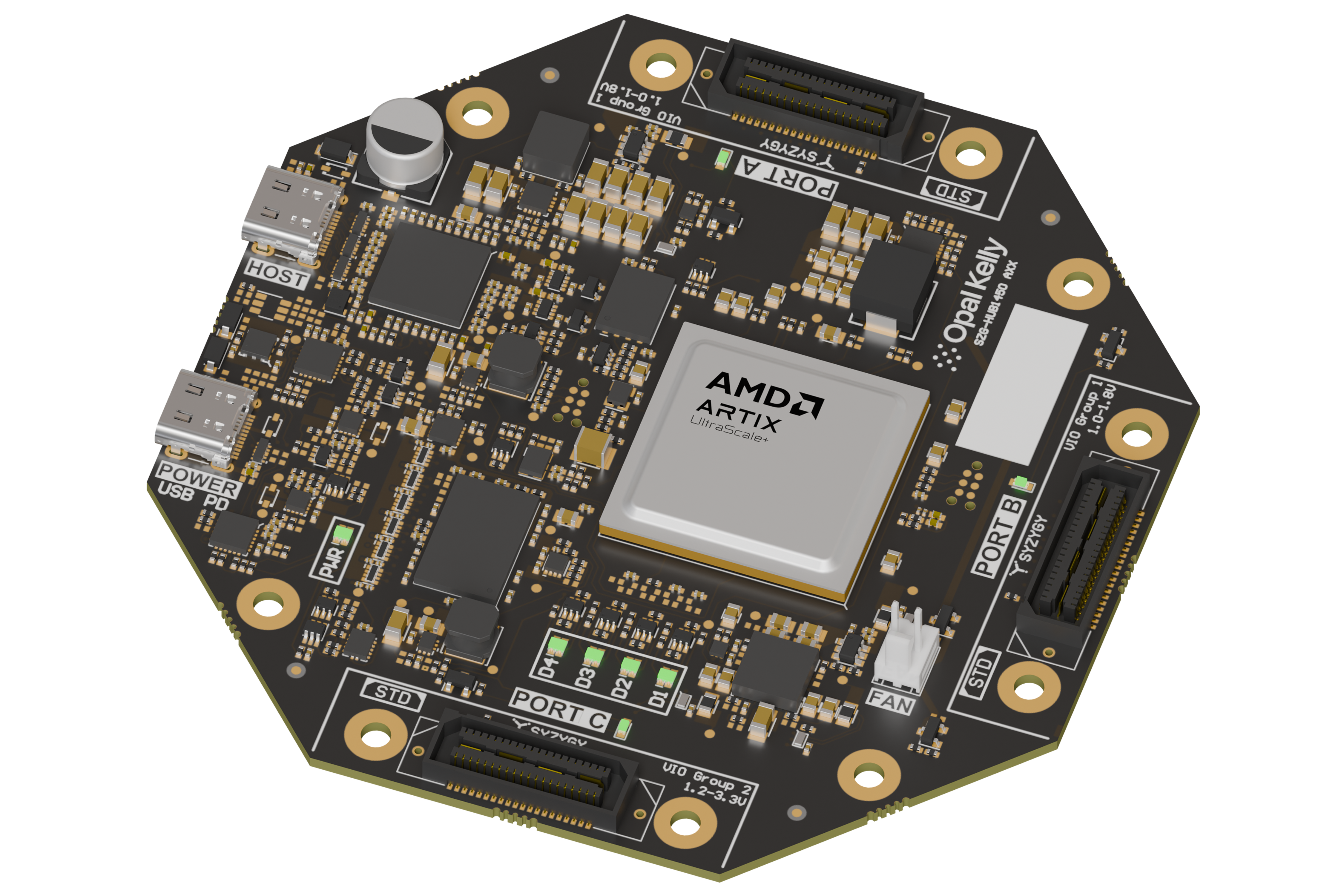
The SYZYGY Hub (SZG-HUB1450) is a compact FPGA evaluation and development platform priced at $499. It puts genuine UltraScale+ fabric, a 10 Gbps USB 3.2 host link, and three swappable SYZYGY expansion ports on a single 100 × 100 mm board, driven end to end by FrontPanel 6. It is built to get you from a sealed box to a working, hardware-connected host application in a single afternoon.
“Most of the time engineers spend designing FPGA-based systems isn’t spent on the FPGA logic at all. It’s spent on the supporting hardware: power supplies, memory, bus interfaces, and the drivers to connect it all to a PC with a UI. The SYZYGY Hub removes that overhead. You plug in one cable, run an example, and you’re working with real data the same afternoon.”
Steve Johnson, President, Opal Kelly
FMC performance. Pmod simplicity. SYZYGY.
For years, FPGA I/O has forced a choice between two extremes. Pmod headers are cheap and easy but limited: low pin counts, low bandwidth, no standardized power negotiation. FMC cards deliver serious performance but bring connector costs, mezzanine complexity, and board budgets that don't make sense for a prototype.
SYZYGY is the open connector standard Opal Kelly created to sit between the two: compact, affordable, and fast enough for real instruments, with smart power negotiation written into the spec. The Hub is the lowest-friction, lowest-cost way to start building on it.
Unlike single-vendor peripheral schemes, SYZYGY is a growing open standard. Opal Kelly owns and maintains it, and licenses the mark for free to encourage a multi-vendor ecosystem of carriers and peripherals.
Serious silicon, without the busywork
The Hub is built for the applications Opal Kelly's modules are already trusted in: data acquisition, instrumentation, software-defined radio, machine vision, photonics, and edge AI.
- AMD Artix UltraScale+ (XCAU10P-1FFVB676E). 96,000 system logic cells, 400 DSP slices, and 3.5 Mib of block RAM in a palm-sized footprint.
- 10 Gbps host interface. USB 3.2 Gen 2 over a single USB-C cable carries both data and power. A dedicated USB-C power port supplies up to 45 W for heavier loads.
- Three SYZYGY Standard ports. HP and HD banks with per-port SmartVIO negotiation: ports A and B at 1.2 to 1.8 V, port C at 1.2 to 3.3 V.
- 1 GiB DDR4 memory and a low-jitter 156.25 MHz LVDS oscillator (2.5 ps RMS) for demanding data paths.
- Driven by FrontPanel 6. Talk to the FPGA over USB from C++, Python, C#, Java and more, with no driver development and no low-level USB code. Then ship browser-based apps in TypeScript and HTML.

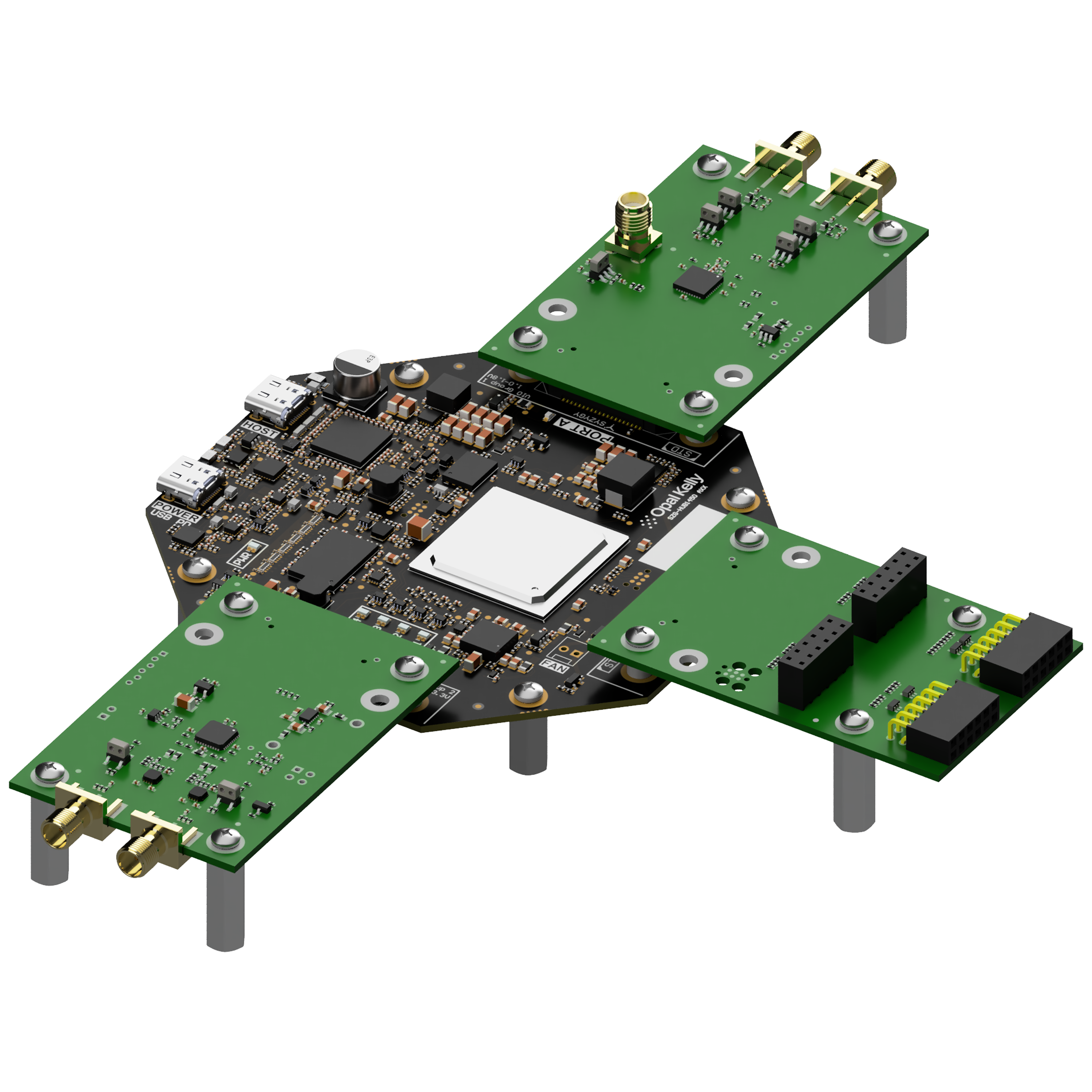
Three ports is enough for a complete signal chain: an ADC on one, a DAC on the second, Ethernet or a sensor breakout on the third. More than ten swappable SYZYGY peripherals work with the Hub today, including high-speed ADC and DAC modules, a 3.4 Mp camera, multi-channel data acquisition, Gigabit Ethernet, and sensor and Pmod breakouts.
Open box to first signal, same day
Every Hub ships with FrontPanel 6: pre-built firmware, synthesizable HDL endpoints (Wires, Triggers, Registers) that drop into your design, and an App Launcher stocked with ready-to-run examples and reference designs. There's no driver development and no low-level USB code to write. Plug in the cable, load a bitfile, and you're moving data, so first capture is a day-one activity rather than a multi-week project.
Releasing with FrontPanel 6.1
6.1 adds support for the Hub across both the SDK and the Platform. It also brings a built-in MCP server for AI-assisted development, rewritten C# and Python wrappers, an AXI stream host interface, faster flash writes, and Windows ARM64 support in beta.

SYZYGY Hub support. Full plug-and-play support for the Hub across the FrontPanel API: C++, Python, C#, Java and more on the host, plus TypeScript and HTML apps on the FrontPanel Platform. Same endpoints, same API, from native code to the browser.
Built-in MCP server, in beta. AI coding tools such as Claude Code and Cursor connect to your FrontPanel app and drive the hardware through it: read endpoints, move data, script experiments in natural language. A host-side application can be described, generated, and pointed at live hardware in one sitting. Try it and tell us how it goes.
New C# and Python wrappers. We overhauled our wrappers so they actually feel native. You can now write C# that feels like C#, and Python that feels like Python.
AXI stream interface. Paired with an AXI stream host interface in the gateware, FrontPanel connects to a design the way the rest of the AMD ecosystem does, streaming into standard IP cores and DSP pipelines without hand-rolled glue logic.
Also in this release:
- Faster flash writes on USB Gen 1 and Gen 2 devices.
- Windows ARM64 support, in beta.
- SDK Export built into the Platform.
- FMC EEPROM write support for the XEM8350.
- New Platform foundations, light and dark app icons, and stability fixes.
Before you upgrade
6.1 drops Python 3.9 and 3.10, and requires JDK 11 or newer for Java.
Who the Hub is for
If you're prototyping a product, the Hub is the shortest path from concept to a demo you can put in someone's hands. If you run a research lab, it's an instrument platform your students can program without learning a USB stack, because the host side lives in Python or the browser. And if you're evaluating SYZYGY or FrontPanel for a larger program, $499 is a low-risk way to find out how the ecosystem behaves before committing to flagship hardware.
The Hub is an easy place to start and an easy place to leave. A design that needs more headroom steps up to the XEM8320 development board, which carries SYZYGY ports of its own. The peripherals carry over, the FrontPanel code carries over, and the HDL endpoints stay where you left them.
Pricing and availability
The SYZYGY Hub (SZG-HUB1450) is available to order now at $499, alongside curated kits (Starter, Vision, Signal Chain, Pro Instrumentation, and Developer) and a build-your-own configurator. SYZYGY peripherals are sold separately and are swappable across all three ports. FrontPanel 6.1 is available now, free for all supported devices.
Learn more
Order the Hub on its own or in a peripheral bundle, and download FrontPanel 6.1.

