


Overview
Overview
This case study, developed by Enginuiti, a group in our experts program, explores the technical advantages of utilizing the Opal Kelly XEM7310 and the FrontPanel API to solve complex interfacing challenges in embedded systems. The report highlights how this platform serves as an accelerated prototyping environment to validate architectures and algorithms months before custom hardware is available. By leveraging the FrontPanel pipeline, engineering teams can bypass the time-intensive process of developing low-level communication protocols—such as USB or PCIe—and instead focus on critical system-level tasks like high-speed data processing and sensor integration.
Company Overview
Company Overview
Enginuiti is an Embedded Engineering Services company that specializes in Yocto-based
embedded Linux, real-time operating systems, and FPGA development with Lattice and
AMD-Xilinx devices. With extensive experience in electrical engineering, firmware, systems
integration, and high-speed hardware design, our team has successfully delivered projects
ranging from space grade control and sensor avionics to high-performance consumer
electronics and research-grade instrumentation.
We partner closely with startups, established enterprises, and research institutions, acting
as an extension of their engineering teams rather than a traditional outsourced vendor.
Enginuiti provides deep technical ownership to our customers with direct client
collaborations. Our expertise spans the full product lifecycle—from initial architecture and
board bring-up through custom Yocto images, kernel driver development, FPGA IP
integration, high-speed PCB design, and compliance testing—ensuring efficient paths from
concept to volume production.
A platform we frequently select for rapid development and proof-of-concept work is the
Opal Kelly XEM7310, a compact USB 3.0 module built around the Xilinx Artix-7 FPGA with
DDR3 memory. The XEM7310 serves as an accelerated prototyping environment that
allows us to validate algorithms, interfaces, and system architectures weeks or months
ahead of custom hardware availability. Using the FrontPanel API, we establish high-
bandwidth communication between host software (running on a Linux or Windows
workstation) and the FPGA, enabling seamless integration of high-speed ADCs/DACs,
image sensors, RF subsystems, or custom processing pipelines. This combination of USB
connectivity, expandable I/O headers, and software tools makes the XEM7310 particularly
well-suited for early-stage product development—allowing Enginuiti to de-risk critical
design decisions and deliver working demonstrations long before final carrier boards or
SOMs are committed to production.
The Challenge of Interfacing
The Challenge of Interfacing
In any embedded system, there is nothing without the interface. An interface provides the means of exchanging information (input/output) between the outside world and the embedded system, without which, nothing could occur. In the course of our work with customers, we often encounter interfaces that are:
• Highly customized / non-standard
• High performance (bitrate)
• Require specialized hardware
• All the above!
Many times, there isn’t an off-the-shelf solution readily available when it comes time to connect with a standard desktop PC for testing the interface. This is precisely the domain where FPGAs come into the picture. Exchanging data between an FPGA and a PC has traditionally required significant time investment to develop in-depth knowledge of protocols such as USB, PCIe, Ethernet, or similar. Getting the implementation of these protocols correct is no small feat and takes time that could instead be spent developing other aspects of the system.
The FrontPanel Pipeline
The FrontPanel Pipeline
This is where Opal Kelly has nailed the solution: take the legwork of getting the data onto & off the FPGA! As shown in Figure 1, Opal Kelly provides the means for doing this easily with their FrontPanel HDL, API, and a little application software.
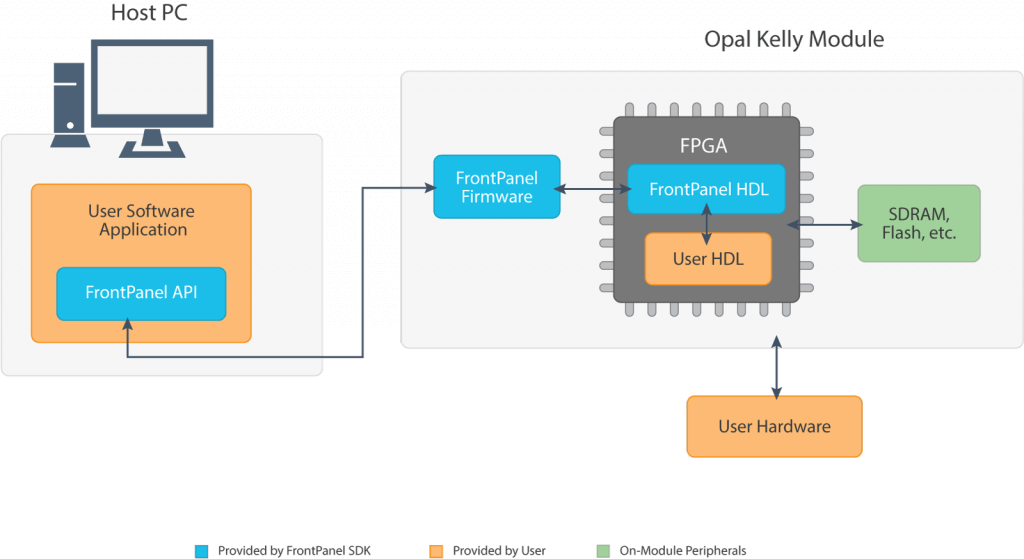
Python or C is the avenue of choice when Enginuiti develops the Application Software
running on the PC, but there are many other languages to choose from.
“In the realm where Commercial Off The Shelf (COTS) solutions do not exist or developing them from scratch would distract from critical development of the deliverable, Opal Kelly’s XEM7310 in combination with the FrontPanel API is a clear winner.”
- Kevin Patel, Embedded Electronics Engineer, Enginuiti
Inside the FPGA, Opal Kelly’s USB 3.0 HDL provides Wire, Trigger, and Pipe hooks among others. Of these, the Pipe In and Pipe Out are best suited for moving large chunks between FPGA and PC. This is because the Pipe In/Out signals: EP_ADDR[7:0], EP_DATAOUT[31:0]/EP_DATAIN[31:0], and EP_WRITE/EP_READ easily map to a 32-bit FIFO in the FPGA fabric.
Any interface that can be boiled down to a 32-bit or arbitrary n-bit (with some marshalling logic) stream can easily be adapted to using the Pipe In/Out constructs. Feeding and consuming from the 32-bit FIFOs are data processing pathways that map directly to pins on the FPGA. Eventually, these pins exit to external circuitry (connectors, ADCs, DACs, transceivers, etc) via a customized carrier board.
The FrontPanel API allows configuration of the FPGA from within the application software (ConfigureFPGA). Not only does this eliminate the need for interaction with the Vivado Hardware Manager or burning the bitstream to nonvolatile flash memory, but it also allows for dynamic configuration of the FPGA at startup. Need to issue an update to the FPGA design? No problem! Just drop the new bitstream into a designated filesystem directory instead of walking through the technical process of reprogramming SPI flash in-field, or worse yet, needing to ship back the hardware.
Once the FPGA has been configured, interaction with the PipeIn and PipeOut can be achieved through either WriteToPipeIn or ReadFromPipeOut. In some cases, you might want to check there is data to be read from the pipe before attempting the read, Wire Out is handy here. Ultimately, whatever your use case is for an FPGA, Opal Kelly modules could significantly streamline your development cycle. See the below technical details to understand if the XEM7310 is right for your application. If so, Enginuiti is here to help your team integrate them.
| OVERVIEW | |
|---|---|
| Host Interface | USB 3.0 Type C, SuperSpeed FrontPanel Support |
| FPGA | XC7A75T-1FGG484C XC7A200T-1FBG484C |
| Memory | 1 GiByte DDR3, 32-bit wide data interface |
| NV Memory | 16 MiB System Flash 16 MiB FPGA Flash |
| Oscillator | 200 MHz |
| FPGA I/O Voltage | See Powering the XEM7310 |
| MODULE SPECIFICATION | ||||
|---|---|---|---|---|
Minimum |
Typical | Maximum | UNITS | |
| DC Input | +4.5 | +5.0 | +5.5 | VDC |
| DC Input Ripple | - | - | 50 | mVp-p |
| Operating Temperature | 0 | - | +70 | C |
| Storage Temperature | -50 | 0 | +100 | C |
| Weight | - | 24 | - | grams |
| Oscillator Frequency | - | 200 | - | MHz |
| Oscillator Freq. Stability | - | ±50 | - | ppm |
| Oscillator Period Jitter | - | 2.5 | - | ps RMS |
| FPGA SPECIFICATION | ||
|---|---|---|
| A75 | A200 | |
| System Logic Cells | 75,520 | 215,360 |
| CLB Flip-Flops | 94,400 | 269,200 |
| CLB LUTs | 47,200 | 134,600 |
| Max. Distributed RAM (Kb) | 892 | 2,888 |
| Block RAM | 210 blocks (3,780 Kb) | 730 blocks (13,140 Kb) |
| DSP Slices | 180 | 740 |
Learn More
Learn More


